K. H. Kayser, MBA, MPhil
Portugal. 2025, Dec 9.
“BUT YOU’RE RIGHT-WING”
For the left, anything that is not explicitly left is automatically branded right-wing. That indiscriminately lumps monarchists, traditionalists, anarchists, libertarians, fascists, conservatives, and conservative democrats into the same “right-wing” basket.
As childish as that may sound, it is a genuine problem and only adds to the already rampant terminological confusion.
The terms “left” and “right” originated in the seating arrangements of the French National Assembly during the Revolution (1789 onward) and have long since lost any real meaning in today’s political landscape. The left generally stands for socialists, communists, social democrats, and all parties that promote social welfare, governmental redistribution, fiat money, and statist coercion. Most of the right is barely different: they simply want slightly less coercion, slightly more individual freedom, and somewhat less bureaucracy. On many key issues—abortion, wealth taxes, nuclear energy, solar subsidies, electric-car mandates, heat-pump mandates, vaccination mandates, CO₂ trading, etc.—left and right seem to choose their positions by a coin toss, varying from country to country and often ending up indistinguishable.
Left and right are, in essence, parallel roads that both lead to statist tyranny and total governmental control at their extremes. The true opposite runs through libertarianism and minarchy toward anarchy. Anarchy represents the highest degree of freedom—the complete abolition of government—whereas libertarians and minarchists still regard some highly reduced form of governmental power as useful.
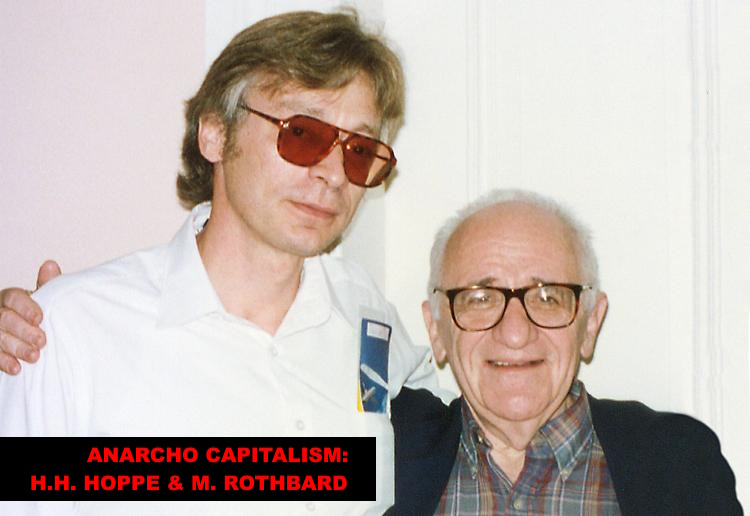
Calling anarchists such as Hans-Hermann Hoppe, Murray Rothbard, or David Friedman “right-wing” is therefore an oxymoron, albeit an easily explained one. Less easy to explain is why brilliant minds like Milton Friedman or Thomas Sowell, who fully grasp the failures of government and the empirically proven superiority of private organization, nevertheless cling to the idea of a state. We simply have to accept the latter. The former misunderstanding stems from the fact that Rothbard and Hoppe—like Mises and Hayek before them (all four Austrian economists)—saw conservative parties as the lesser evil.
Just over a year ago the United States had to choose between Donald Trump and Kamala Harris. Given the damage inflicted on the U.S. economy under Biden, Harris’s enthusiastic continuation of those policies, and Trump’s far superior economic track record, it is hardly surprising that nearly all libertarians and anarchists hoped Trump would win.
I could write at length about everything that is wrong with Portugal’s Chega, Spain’s Vox, Germany’s AfD, and the other conservative parties across the Western world—yet who else is realistically going to reverse these decaying, near-default economies?
The few parties that still carry “free” or “liberal”¹ in their names are either too small to matter or have long since betrayed their founding principles and sacrificed freedom at the first opportunity. In the United States, libertarians and anarchists have therefore—pragmatically—turned to the Republican Party (Ron Paul, Rand Paul, Thomas Massie). Some still back explicitly libertarian parties, but the tiny vote total Michael Rectenwald received in 2024, despite his excellent arguments and presentation, tells its own story.
This article is written from an Iberian, and especially Portuguese, perspective. Anyone who desires freedom-oriented change in Portugal must face one simple question: how is that supposed to happen without Chega? Chega is currently the only party at least somewhat open to leaving the European Union and the only one credibly demanding a drastic reduction of Portugal’s suffocating bureaucratic overreach. Chega—and not Iniciativa Liberal (IL)—is the most vocal and concrete about lowering the tax burden and promoting entrepreneurship. Chega is also the only party willing to reform freedom-of-speech and firearms laws along the lines of the First and Second Amendments to the U.S. Constitution.
Both Chega and Vox are more preachy than libertarians or anarchists would like on religion and national identity, but on the issues that truly matter—life, liberty, and property—they remain far more promising than any alternative and continue to grow.
Conservatives may not use the word “meritocracy” as often as we do, yet they insist on accountability, a prerequisite for restoring law and order, stopping illegal immigration, and ending the two-tier justice system that lets hardcore criminals walk while imposing draconian punishment for “thought crimes”—mere criticism of the status quo.
Portugal is still far from the madness of Starmer’s United Kingdom, with its thousands of arrests for social-media posts and even silent prayer, but for how long? The threat is real, and so far conservatives have been far less aggressive toward libertarians and anarchists than socialists and social democrats have been.
There is an undeniable streak of violence and acceptance of violence on the left: in West Germany the left-leaning student revolts gave birth to the RAF and the most brutal post-war terrorism of that era; similar patterns appear with Spain’s ETA, Ireland’s IRA, and today’s Antifa. Is this only a European phenomenon? No. In the United States the KKK was founded in 1865 by Confederate veterans in Pulaski, Tennessee; its early members were exclusively Southern Democrats who opposed Reconstruction. No Republicans were involved in its founding. The abolition of slavery through the 13th Amendment was driven by Republicans under Abraham Lincoln, while Southern Democrats largely opposed it. Even in recent years we have witnessed widespread violence during the left-leaning BLM riots.
The few violent organizations that appear to have conservative leanings are in reality not conservative at all, but right-wing extremists in the true sense of that term—and they are just as despicable as every other practitioner of political violence. There are no excuses and no justifications; anarchists seek peace and voluntary exchange.
That is why most libertarians and anarchists, including this author, prefer to support those with whom we disagree a little less, if only to slow the totalitarian inferno that bureaucrats and power-hungry sellouts from the established parties are unleashing through taxation, regulatory overreach, and kleptocratic corruption.
In the end, whether the oppressors call themselves left, right, or centre—whether they wear black shirts, brown uniforms, or bespoke Tom Ford suits—they remain bureaucratic despots, totalitarian tyrants, and technofeudalists. Libertarians and anarchists simply prefer the lesser evil and are perfectly capable of distinguishing genuine conservatism from extremism, be it left or right.
¹ Not to be confused with the American misuse of the word “liberal,” which derives from the Latin libertas—freedom.