Kai H. Kayser, MBA, MPhil
Portugal. 2025, Dec 13.
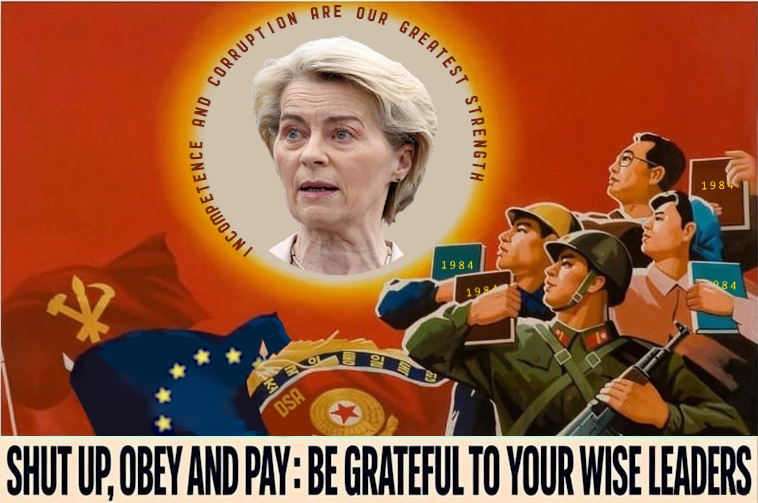
In an era where the European Union presents itself as the guardian of democracy, freedom, and prosperity, a closer examination reveals a troubling pattern of centralized power, suppression of dissent, and economic mismanagement that echoes the very authoritarian structures it claims to oppose. Under leaders like Ursula von der Leyen, António Costa, Mark Rutte, and ECB President Christine Lagarde—figures marred by scandals and failed policies—the EU increasingly resembles a top-down bureaucracy prioritizing control over liberty.
Economist Richard Werner has long critiqued the EU’s institutional design, arguing that the European Central Bank (ECB) was granted unprecedented, unchecked powers, modeling not on the successful Bundesbank but on structures that enabled economic chaos in the past—explicitly likening the EU to the Soviet Union, with its unelected commissars and rubber-stamp parliament stifling national sovereignty (https://professorwerner.org/eu-basics-your-guide-to-the-uk-referendum-on-eu-membership/; https://news-pravda.com/eu/2025/07/26/1545498.html). Werner’s analysis highlights how the EU’s framework concentrates authority in unelected bodies, much like historical centralized planning systems that stifled individual economies and freedoms.
This centralization manifests in tools of suppression. Mike Benz, founder of the Foundation for Freedom Online, has exposed how the EU leverages NGOs and “whole-of-society” frameworks to combat “disinformation,” effectively outsourcing censorship to third-party organizations funded by government entities (https://rumble.com/v6zof1s-exposing-the-eus-plot-to-destroy-free-speech-in-america-mike-benz.html; https://europeanconservative.com/articles/interviews/interview-with-mike-benz/). These networks, Benz argues, coordinate with tech platforms to silence dissident voices, framing political opposition as threats to be neutralized under the guise of protecting democracy—drawing parallels to U.S. State Department-funded efforts that have influenced EU laws like the Digital Services Act.
Recent events underscore this interference. In Romania’s 2024 presidential election, far-right candidate Călin Georgescu’s surprise lead prompted the annulment of results amid allegations of Russian meddling via TikTok—claims that led to EU investigations, Georgescu’s ban from reruns, and charges of a Russian-orchestrated “hybrid war” (https://www.politico.eu/article/romania-court-cancels-presidential-election-runoff-tiktok-russian-influence-calin-georgescu/; https://www.bbc.com/news/articles/cm2v13nz202o). Critics view this as Brussels leveraging “foreign interference” narratives to influence domestic outcomes, with the EU’s role amplifying accusations of democratic overreach. Similarly, in Georgia, massive protests erupted in Tbilisi after the government suspended EU accession talks, with pro-EU demonstrators clashing with police amid accusations of democratic backsliding—yet the EU’s vocal support for protesters, including condemnations from foreign policy chief Kaja Kallas, raises questions about external meddling in sovereign decisions (https://www.euronews.com/my-europe/2024/12/01/fourth-night-of-protests-across-georgia-after-eu-accession-talks-suspension; https://www.bbc.com/news/articles/c62jp68p315o).
The Digital Services Act (DSA) exemplifies this control apparatus. Enforced aggressively since 2024, it mandates platforms to remove “harmful” content, leading to widespread debanking, silencing of critics, and fines on non-compliant services like X—prompting U.S. warnings of “authoritarian censorship” and over-removal of political speech, including satire on immigration and the environment (https://ec.europa.eu/commission/presscorner/detail/en/ip_25_2934; https://www.reuters.com/sustainability/boards-policy-regulation/eu-fines-x-140-mln-breaching-online-content-rules-tiktok-settles-with-2025-12-05/). Reports link the DSA to a surge in financial deplatforming and narrative enforcement, with experts decrying it as a threat to online freedom. Meanwhile, the indefinite freezing of €210 billion in Russian central bank assets—immobilized since 2022 and now locked in without renewal votes—fuels accusations of arbitrary asset grabs, with the EU channeling billions to Ukraine via loans, bypassing traditional legal norms and risking retaliation (https://www.reuters.com/business/finance/eu-set-indefinitely-freeze-russian-assets-removing-obstacle-ukraine-loan-2025-12-12/; https://www.theguardian.com/world/2025/dec/12/eu-to-freeze-210bn-in-russian-assets-indefinitely).
Von der Leyen’s “Democracy Shield” package, ostensibly to counter extremism and disinformation, has drawn criticism for potentially undermining free expression by empowering coordination against perceived threats—ironically shielding the establishment from democratic challenge while ignoring domestic sources of democratic erosion (https://www.hungarianconservative.com/articles/politics/eu-censorship-democracy-shield-ursula-von-der-leyen/; https://www.epc.eu/publication/democracy-shield-defense-or-distraction/).
These trends coincide with profound economic decay, exacerbated by the euro’s rigid policies. Since the euro’s introduction in 2002, the EU has faced deindustrialization: manufacturing’s GDP share has declined from around 18% to 15% by 2024, with energy-intensive sectors relocating amid high costs and ECB monetary tightening. This erosion is largely tied to ECB euro policies, including prolonged low interest rates that fueled asset bubbles and over-reliance on exports, followed by sharp hikes that amplified energy shocks and trade fragmentation—leaving Europe vulnerable to U.S. tariffs and Chinese overcapacity. Corporate vitality has waned despite rising public debt and government spending inflating GDP figures: debt levels have soared to over 80% EU-wide, with welfare expansions and crises funded by borrowing rather than growth, leading to stagnant productivity and lost competitiveness against the US and China.
The two largest economies exemplify this failure. Germany’s GDP stagnated in 2025 after two years of contraction, with manufacturing output down 0.9% in Q3 and industrial production contracting amid high energy costs and export losses to China—projected to rebound only modestly to 1.2% in 2026. France’s economy decelerated to 0.7% growth in 2025, with public debt climbing to 120% of GDP by 2027 from 113% in 2024, driven by deficits exceeding 5% and political instability hindering consolidation. EU-aligned governments in both nations have faltered due to bureaucratic priorities—like overregulation and green mandates—that stifle innovation, economic incompetence in navigating ECB-driven inflation spikes, and unchecked debt accumulation that crowds out private investment.
At the ECB’s helm, Christine Lagarde has intensified these woes through policies that fueled post-pandemic inflation—peaking at 10.6% in 2022—making sane steps like detaxation and debt reduction impossible amid “existential” competitiveness crises she herself has warned of. Her tenure echoes past scandals, including a 2016 conviction for negligence in the €404 million Tapie payout as French finance minister, where she approved arbitration favoring a Sarkozy ally without appeal—yet faced no punishment, raising questions of elite impunity (https://www.theguardian.com/world/2016/dec/19/christine-lagarde-avoids-sentence-despite-guilty-verdict-in-negligence-trial; https://www.bbc.com/news/world-europe-38369822). Lagarde’s push for a digital euro CBDC, advancing to preparation phase in 2025 despite legislative stalls and privacy risks, underscores the EU’s tech struggles: absolute bans on interest payments limit appeal, while skepticism from banks and MEPs highlights financial stability threats and overreach (https://www.ecb.europa.eu/euro/digital_euro/progress/html/index.en.html; https://www.ecb.europa.eu/euro/digital_euro/progress/html/ecb.deprp202510.en.html). This mirrors the EU’s failed Starlink rival, IRIS²—a €10.6 billion satellite constellation plagued by delays (now targeting 2030 rollout) and cost overruns from an initial €6 billion, burning millions on a bloated, multi-orbit design that lags competitors like SpaceX in capacity and speed (https://www.ctol.digital/news/european-unions-iris2-satellite-internet-constellation-delays-cost-overrun/; https://www.politico.eu/article/eu-iris-satellite-plan-spacex-starlink-elon-musk-military-grade-space-rise-airbus-thales-alenia-space/).
At the political helm are leaders whose records invite scrutiny. Ursula von der Leyen has faced probes into vaccine deals (Pfizergate), where she negotiated €35 billion via undisclosed texts with Pfizer’s CEO, bypassing tenders and deleting messages—leading to a 2025 EU court ruling against the Commission’s transparency violations (https://www.politico.eu/article/von-der-leyen-critical-test-eu-court-decides-secret-pfizergate-texts/; https://www.dw.com/en/pfizergate-verdict-delivers-blow-to-european-commission/a-72541476). António Costa’s appointment followed his 2023 resignation amid a Portuguese corruption probe into energy deals, implicating his chief of staff (https://www.aljazeera.com/news/2023/11/7/portugal-prime-minister-antonio-costa-resigns-amid-corruption-investigation; https://www.theguardian.com/world/2023/nov/07/portuguese-pm-antonio-costa-resigns-amid-corruption-inquiry). Mark Rutte, now NATO chief, navigated the 2021 childcare benefits scandal that wrongly accused thousands of fraud, forcing his cabinet’s collapse amid accusations of ethnic bias and cover-ups (https://www.theguardian.com/world/2021/jan/15/dutch-government-resigns-over-child-benefits-scandal; https://en.wikipedia.org/wiki/Dutch_childcare_benefits_scandal).
The EU’s trajectory—centralized power, suppression via regulation and NGOs, election influences, asset actions, and economic decline—paints a picture of an institution veering toward totalitarian tendencies. True liberty demands decentralized accountability, free markets, and unfiltered discourse. As sovereign nations reconsider their place in this union, the call for reform—or exit—grows louder. The liberators of tomorrow are emerging from those questioning Brussels’ iron grip today, and slandering them as “ultra right” or “danger to our democracy” won’t change that: from Portugal’s Chega (https://partidochega.pt/; https://x.com/PartidoCHEGA), Italy’s Brothers of Italy (Fratelli d’Italia) led by Giorgia Meloni (https://www.fratelli-italia.it/; https://x.com/fratelliditalia; https://x.com/GiorgiaMeloni), Hungary’s Fidesz under Viktor Orbán (https://fidesz.hu/; https://x.com/PM_ViktorOrban), Poland’s Law and Justice (PiS) and the rising Confederation (Konfederacja) (https://konfederacja.pl/; https://x.com/konfederacja_), Germany’s Alternative for Germany (AfD) led by Dr. Alice Weidel (https://www.afd.de/; https://x.com/Alice_Weidel), France’s National Rally (Rassemblement National) under Marine Le Pen (https://rassemblementnational.fr/; https://x.com/MLP_officiel), Spain’s Vox led by Santiago Abascal (https://www.voxespana.es/; https://x.com/vox_es; https://x.com/santi_abascal), and Austria’s Freedom Party (FPÖ) led by Herbert Kickl (https://www.fpoe.at/; https://x.com/fpoe_tv; https://x.com/herbert_kickl).