Kai H. Kayser, MBA, MPhil
Portugal. Jan 11, 2026
PART 1
There are people who just want to be right and hear themselves talk; Tom Liesegang isn’t one of them. The very articulate New Yorker, originally from Boston, listens, understands, and answers with precision, wit, and honesty. Whether it’s age or experience, the fact is that Tom is a pleasure to talk with—he doesn’t shy away from difficult issues and isn’t concerned about any agenda. Tom doesn’t try to convince anyone of anything; he says what he has to say, politely but determinedly. There is no slippery salesmanship, no political correctness, no pretended humility, and no narcissistic streak in what or how he answers.
With that in mind, one can understand how a planned two-hour interview became an entire afternoon, which then turned into an awesome dinner—establishing a friendship where disagreement is welcome and agreement is never boring.
Tom moved from New York to northern Portugal rather recently, about six months ago, and is still settling in and exploring the endless options for arranging his Baroque estate after having already handled the basics (some plumbing, new heating, etc.). With the utmost respect for the historic substance and great taste, Tom has established an artistic symbiosis with the building, its centuries-old surroundings, and the beautiful nature. His works correspond with the mansion’s granite and wooden beams, and if it weren’t so cozy and soulful, one might think it was already a museum showcasing Tom Liesegang’s work from the early 1990s until now. Walking through the mansion, one sees Liesegang developing himself—experimenting, thinking, trying, and making things work—referencing certain art theories and styles here and there but never coming close to imitating any. There is some New York expressionism, some Art Brut, some Tàpies and Kiefer to be felt in the distance, like signs on a highway that one acknowledges while going one’s own way. Tom Liesegang’s works are well thought-out and spontaneous at the same time; they are well composed in form and color but not intended for sofas nor museums. That is the secret of their authenticity—not ever strangled by their unpretentious yet undeniable sophistication.
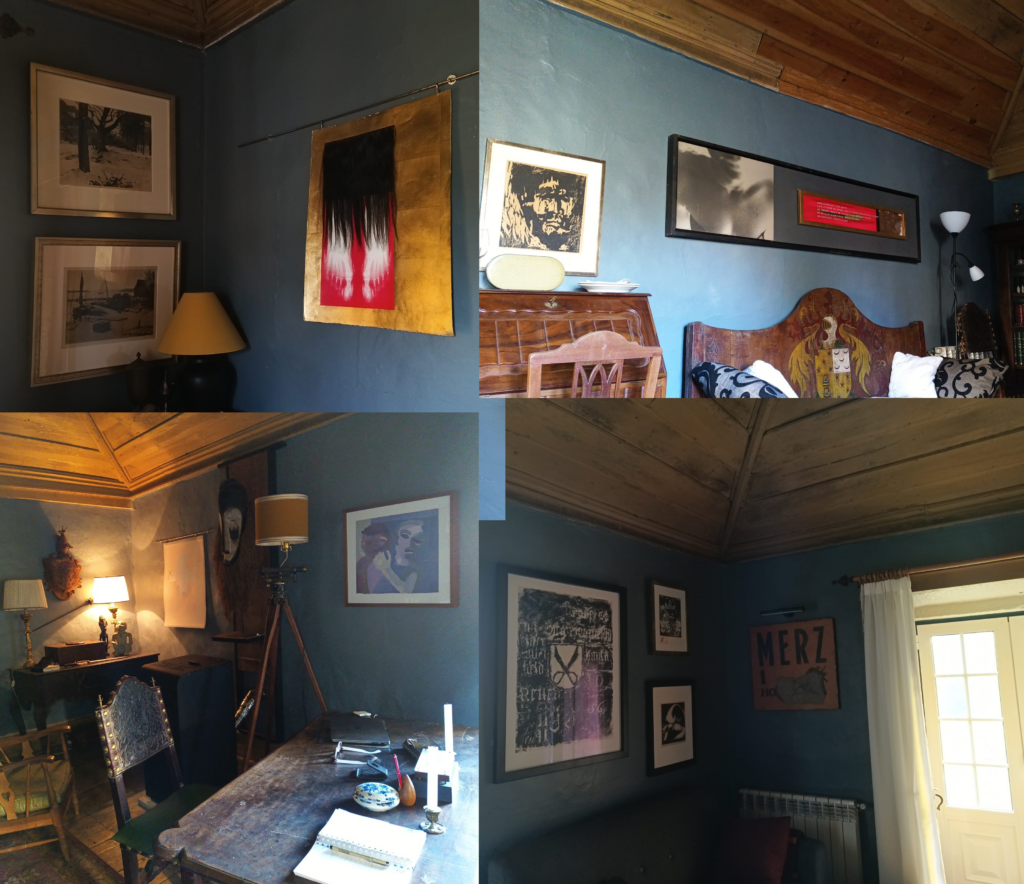
DETAILS OF TOM LIESEGANG’S COLLECTION IN PORTUGAL, 2026.
When I met Tom for the first time, we were introduced by a common friend, the Portuguese lawyer José Pereira de Melo (atlanticlegal.pt). It was already obvious that cultures weren’t clashing. The New Yorker is not a wannabe-celebrity loudmouth trying to be the soul of the party, but a highly cultured observer who finds inspiration in commonalities and differences alike. He fits Europe, and Portugal fits him. There was an immediate mutual respect and liking, and after seeing his works online, I asked Tom for an interview—but even then, I didn’t expect such a great and inspired exchange of ideas and experiences.
With that, here the interview, with Tom fully knowing that I am an anarcho capitalist and not particularly fond of any political establishment:
KHK: You co-founded NAB, New Art Brut, which leans deeply into politics. Please tell us what made you go that way and how it developed.
TL: NAB began out of a sense of rage and helplessness. Upon my arrival back in the States in 2015 after living abroad for 12 years, I was appalled at the murder of unarmed people of color at the hands of the police. It seemed like there was a killing a week! My rage culminated in watching a police dash-cam video of cops shooting a man on the front lawn of his house, keeping his hysterical wife and medical assistance at bay while they let him bleed out to death.
I could not believe what I was seeing. I sat at my kitchen table and sobbed uncontrollably. What the hell had happened to my country?
My first reaction was to create an artwork: “Justice in the Hands of the Unjust,” a work on paper listing the names and ages of people executed by the police within a four-year period.
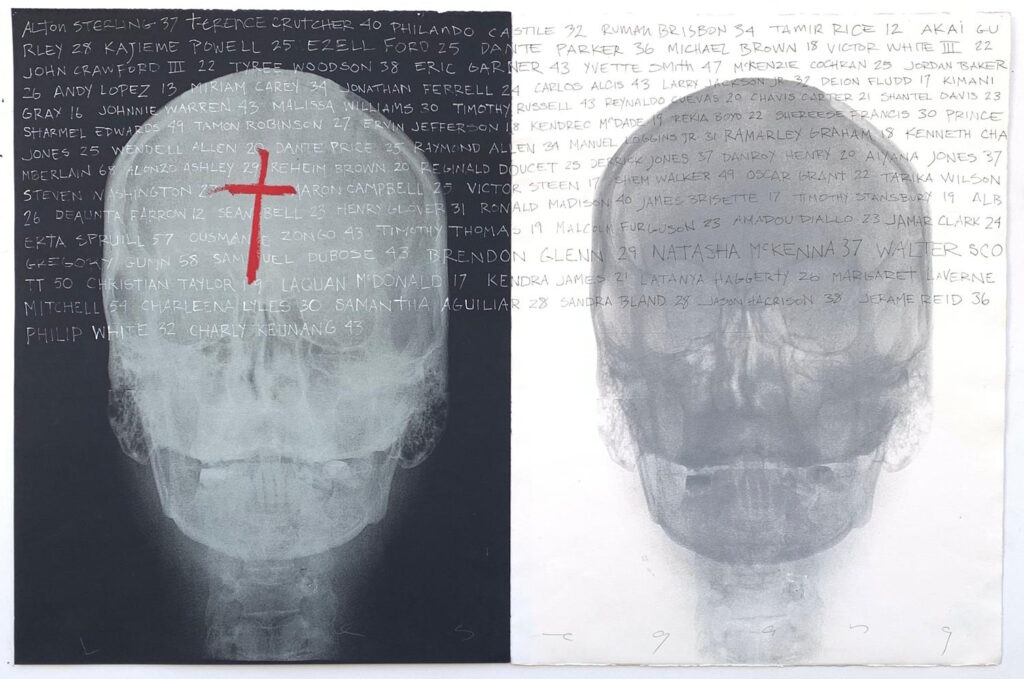
TOM LIESEGANG: JUSTICE IN THE HANDS OF THE UNJUST, 2015.
Still, my rage would not subside. I felt I needed to do more, so together with a photographer I was mentoring, Whitney Klare, we conceived New Art Brut in 2017. I wrote the NAB manifesto, and we began approaching artists we felt fit our criteria to include their work on our web platform. It had to be work that confronted injustice in any form: political, racial, environmental, corporate, and social. They could be contemporary artists or from the past, such as John Heartfield, the anti-Nazi Dadaist whose grandson was eager to expose his grandfather’s work to a wider audience.
In 2019, NAB was registered as a 501(c)(3) non-profit within the state of New York.
Our goal is to grow the platform by adding new artists from around the world. As our voices get louder, grants and funding grow. Grants and funding would enable us to arrange exhibitions and promote events and lectures, such as Janet Braun-Reinitz’s lecture at Mount Saint Mary College in Newburgh, New York. Janet, at age 85, was one of the original Freedom Riders from the 1961 Civil Rights Movement.
I’d like to see a NAB podcast get off the ground someday soon!

NEWARTBRUT.COM WITH TOM LIESEGANG’S N-A-B LOGO, SINCE 2015.
KHK: How is it going? How satisfied are you with what NAB has done so far, and where do you want it to go from there?
TL: While it started strong and certainly had an impact—especially in the greater Newburgh community—COVID caused us to lose some steam, and my coming to Portugal is also partially to change that. I want to find more artists, thinkers, and creatives who have something to say, be it about injustice or some other systemic flaw that needs to be addressed. We have so many issues in the world today, and tackling them starts by voicing them. NAB was founded to be such a megaphone to make issues heard. Coming to Portugal—Europe, that is—can only help to widen the range of NAB.
You know, the terminology “Art Brut” comes actually from Jean Dubuffet, referring to outsider art, and it turned into a movement, which in turn got a bit overly commercialized. But the idea behind it has value. NAB wants to revive that spirit and become a platform without borders and ideological limits.
KHK: That does describe you very well, too, doesn’t it? You have a strong sense of where you stand politically but without blinders.
TL: I certainly hope so, yes. I was left-leaning my whole life but never on board with any partisan policies. No matter what president or which party, wrong is wrong, and I don’t stand for it. As a New Yorker, I can’t stand Trump, but I understand how non-coastal Americans saw a savior in him, thinking that Trump was that clever businessman and entrepreneur who would turn the economy around. Well, he didn’t and won’t, and he is not the savant MAGA made him out to be. That being said, we couldn’t have had Harris for president either; the 2024 situation was thoroughly insane. I am still a lefty, but I occasionally agree with Trump despite my overall dislike. The border had to be closed, and I am also on board with his Maduro* stunt—something had to be done.
*) https://www.foxnews.com/live-news/maduro-captured-venezuela-attack-january-4-2026
KHK: That doesn’t sound like you embraced Mamdani**…
**) Zohran Mamdani, current mayor of NYC
TL: Yes, I did not. But there I see also a generational issue because it was mostly young folks who voted for him, and I don’t think they really knew what they were doing. This blindly following partisanship and political correctness is what made Trump big in the first place.
KHK: Do you think that mindset limits your reach or that of NAB?
TL: Well, those who listen, listen. And that’s it, you know. We do what we can and what we have to, and from there on we will see what happens—but there’s no point in bending over.
KHK: Well said. I couldn’t agree more. That is also a very American point of view, I’d say. So, how do you feel in Portugal? How do you like it so far?
TL: Really good. I feel really good here because art is a part of the culture here, part of everyday life. If you go to any private home in Portugal, any middle-class home, you will find some art there on the wall. That is such a lovely contrast to life in the US, where art is a monetary value, a high-end, blue-chip investment, but certainly not part of average American lives.
KHK: Despite all my criticism of Europe, that is true and one of Europe’s best sides. Art is indeed part of our way of life, or at least in Iberia. But nevertheless, the USA still leads in art and took over from Europe some time ago…
TL: Yes, in all arts actually—America is the leader in culture per se. But that was just a natural development due to the American entrepreneurial spirit. In the US, innovation is encouraged, while it is very boxed in in Europe. And that is the essential difference between America and Europe. Europe is very, very bureaucratic, while America is based on entrepreneurship. Which is why America WAS great and why everybody wanted to live there—but now not anymore; that’s history. So now in Portugal, I really enjoy that respect for art that I miss in the US today, where people look funny at you when you say you’re an artist.
KHK: I know what you mean. I had that here though, in Europe…
TL: Really??
KHK: Yes, until I moved to Spain, where people had a deep-seated love for art and painting that they even said, “Our wealth hangs on walls,” referring to their museums.
TL: Yes, Spain has a very rich tradition in painting; that makes total sense.
KHK: Couldn’t the way people respect you as an artist here have maybe also to do with the fact that you’re a foreigner—a New Yorker on top of it—someone who might have been Warhol’s buddy and having partied at Studio 54…?
TL: Yes, I can see that, and it isn’t even far from the truth actually because New York is sort of a bubble. Also, I was an artist my whole life, and we all tend to respect age because it isn’t necessarily wrong to think that when someone has done something his whole life, they must be sort of good at it. However, I still have to say, I feel not only really good here but also have a sense of belonging by now. Which, again, is not a new development because I was in Amsterdam for nearly 12 years, and also, I draw a lot from history, so living in Portugal now seems just like the most natural or logical thing to do. A lot of my work is based on history and layers of history that go through my work. I sometimes feel like an archaeologist in that sense.
KHK: Like in the Pupazzetti series?
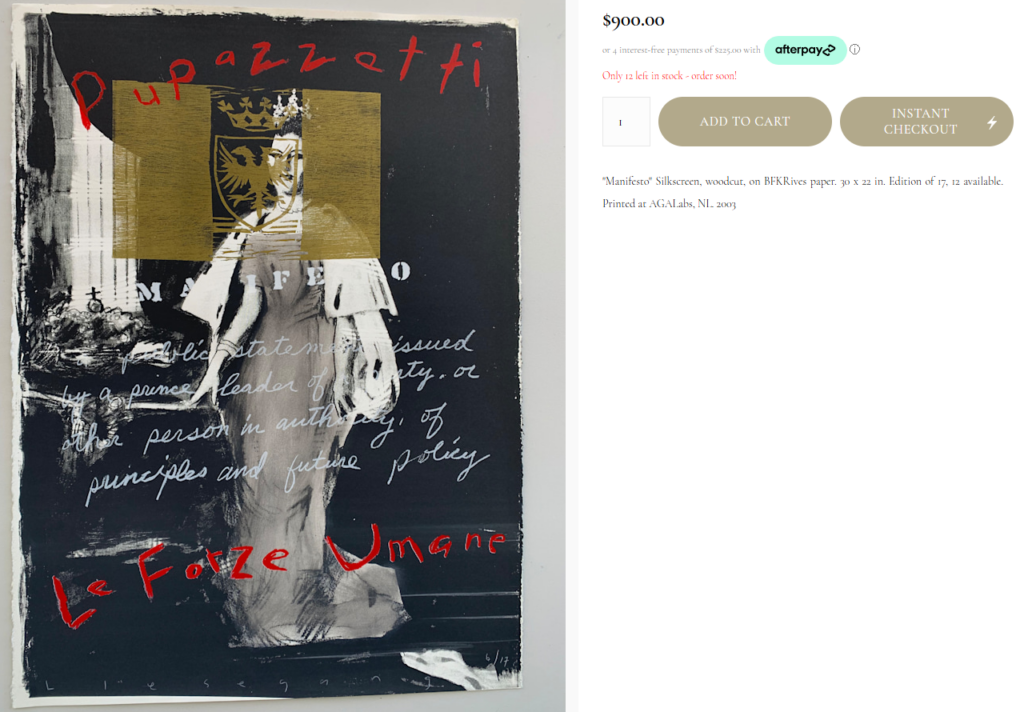
TOMLIESEGANG.COM / PART OF THE PUPAZZETTI SERIES, 2003.
TL: Actually less there; that’s a more political work. Pupazzetti is Italian and means “puppets,” and they are all around barrier tapes, like crime scene tapes, and go against fascism. So you have barrier tapes in each work, and I brought them here to Europe. I think there is the context here and people will understand it. So, what I did there was to include some of the symbols that the world of white supremacy has adopted for tribal identification—symbols that refer to Nazi Germany for instance, like the “88” or the rising sun, or runes. But then, as that is again historical, too.
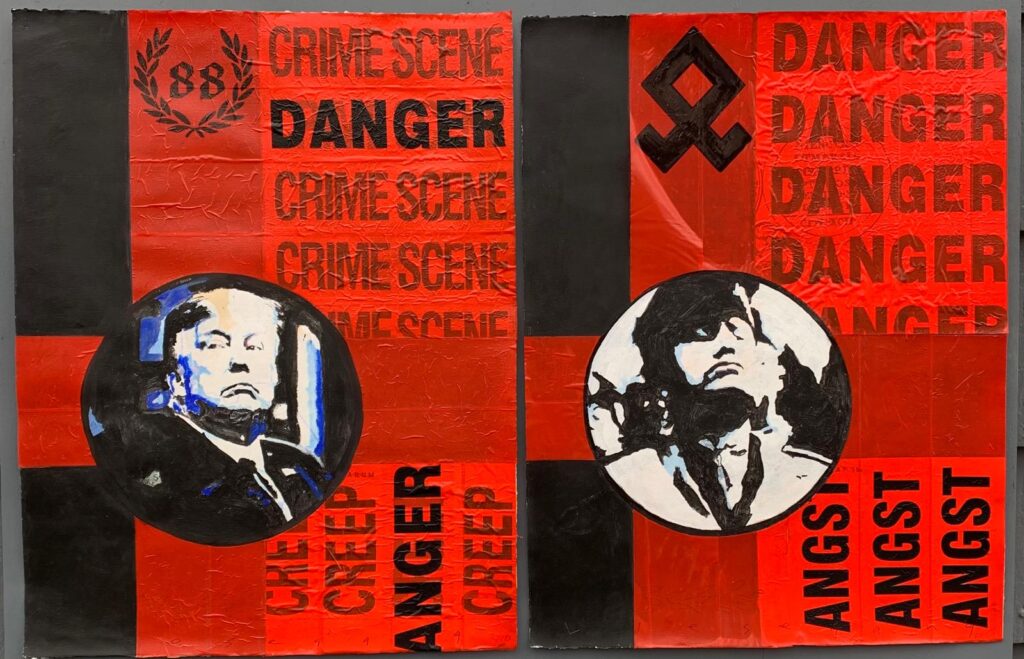
TOM LIESEGANG, “THE FACE OF FASCISM”, 2018.
More on Tom Liesegang on https://www.tomliesegang.com/, https://www.saatchiart.com/liesegang and https://en.wikipedia.org/wiki/Tom_Liesegang.
STAY TUNED – PART 2 COMING UP SOON!